Introduction
In a world where artificial intelligence can diagnose diseases in seconds, compose symphonies, and solve complex mathematical theorems, we face an unprecedented paradox. Mo Gawdat, former Chief Business Officer at Google X, captured this contradiction with a phrase that cuts to the heart of our modern crisis: “Super smart AI reporting to stupid leaders.”
This isn’t merely a critique of current leadership, it’s a mirror reflecting humanity’s deepest flaws and our most urgent challenge. As we stand at the threshold of an AI-dominated future, we must confront an uncomfortable truth: our technology has evolved far beyond our wisdom.
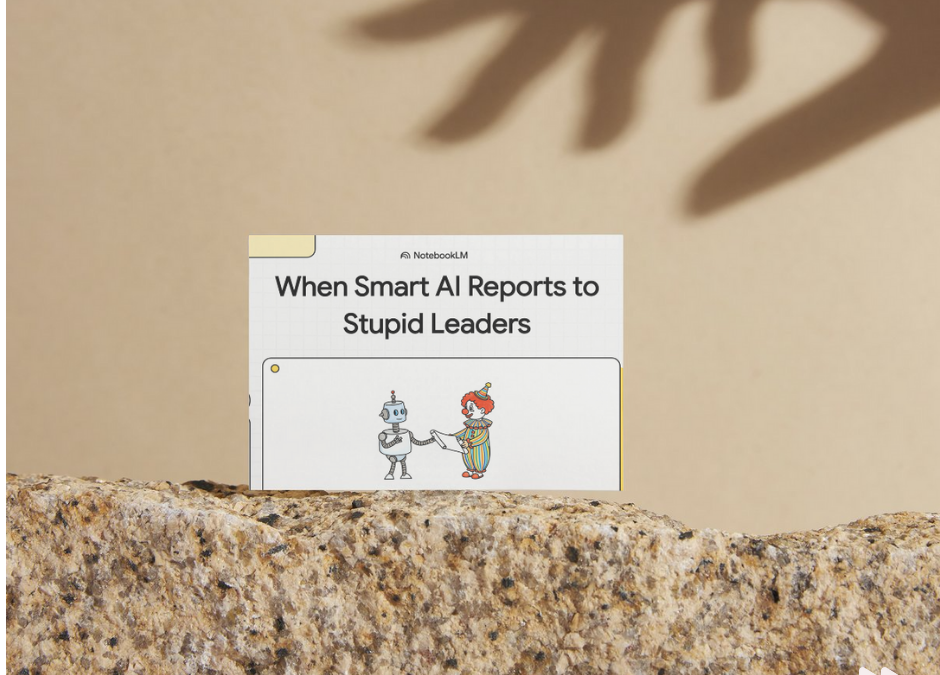
Generated with NotebookLM based on my scenario
The Historical Pattern: Power Without Wisdom
The Confusion of Authority with Intelligence
Throughout history, humanity has consistently made the same fundamental error: we have confused power with wisdom, influence with intelligence, and control with competence. We have elevated leaders not for their vision, compassion, or long-term thinking, but for their ability to accumulate resources, win conflicts, and maintain dominance.
Consider the pattern:
- Ancient civilizations often chose rulers based on military prowess or hereditary claims, not wisdom
- Industrial leaders were celebrated for their ability to extract profit, regardless of human or environmental cost
- Modern politicians are selected for their capacity to win elections, not their ability to solve complex global challenges
This systematic elevation of the wrong qualities has created a leadership class ill-equipped to handle the profound responsibilities that come with superintelligent AI.
The Architecture of Division
Another critical mistake has been our tendency toward division rather than unity. We have constructed barriers, national, religious, economic, and ideological, that fragment our collective intelligence and prevent coordinated responses to global challenges.
The Technology-First Mentality
Building First, Thinking Later
Perhaps our most dangerous pattern has been the consistent prioritization of technological capability over ethical consideration. We have repeatedly created powerful tools without adequately considering their implications:
The Industrial Revolution: We built factories that transformed production but devastated communities and environments, only later developing labor laws and environmental protections.
Nuclear Technology: We created weapons capable of destroying civilization, then scrambled to develop non-proliferation treaties and safety protocols.
Social Media: We connected the world digitally but created platforms that amplify misinformation, polarization, and mental health crises.
Artificial Intelligence: We are now developing systems that could surpass human intelligence in all domains, yet our governance frameworks, ethical guidelines, and safety measures lag far behind.
The Acceleration Problem
The pace of AI development has created an unprecedented challenge. Unlike previous technologies that evolved over decades or centuries, AI capabilities are advancing exponentially. This acceleration leaves little time for the gradual development of wisdom, regulation, and social adaptation that previous technological revolutions allowed.
The Empathy Deficit in Leadership
The Devaluation of Compassion
Modern leadership selection and development systems have systematically devalued empathy, treating compassion as weakness rather than strength. We have created cultures that reward:
- Ruthless competition over collaborative problem-solving
- Short-term profit maximization over sustainable long-term thinking
- Authoritarian control over inclusive decision-making
- Individual achievement over collective wellbeing
This empathy deficit becomes catastrophic when applied to AI development and governance. Leaders who lack compassion cannot adequately consider the human impact of AI systems, leading to technologies that optimize for efficiency while ignoring human dignity, autonomy, and wellbeing.
The Measurement Problem
Our leadership evaluation systems focus on easily quantifiable metrics, stock prices, GDP growth, electoral victories, while ignoring harder-to-measure but more important qualities like wisdom, empathy, and long-term thinking. This creates a selection bias toward leaders who excel at gaming systems rather than solving complex human problems.
The AI Mirror: Reflecting Our Worst Tendencies
Learning from Flawed Teachers
Artificial intelligence systems learn from human-generated data, which means they inevitably absorb and amplify our biases, mistakes, and moral blind spots. When we train AI on:
- Historical texts filled with prejudice and discrimination
- Economic models that prioritize profit over people
- Political discourse characterized by division and manipulation
- Social media content that rewards outrage and polarization
We create systems that perpetuate and amplify humanity’s worst tendencies.
The Amplification Effect
AI doesn’t just copy human flaws, it amplifies them. A biased human decision affects individuals or small groups. A biased AI system can affect millions or billions of people simultaneously. When “stupid leaders” guide AI development, their limitations become embedded in systems with unprecedented reach and influence.
The Wisdom Crisis in AI Governance
Current Leadership Inadequacies
Today’s AI governance reveals the depth of our leadership wisdom deficit:
Corporate Leadership: Many tech executives prioritize market dominance and shareholder value over safety and social benefit. They rush to deploy AI systems without adequate testing or consideration of societal impact.
Political Leadership: Most politicians lack the technical understanding necessary to create effective AI policy. They often respond to AI challenges with outdated regulatory frameworks designed for previous technological eras.
Academic Leadership: While many researchers understand AI’s technical aspects, academic incentive structures often prioritize publication and funding over careful consideration of long-term implications.
International Leadership: Global governance institutions struggle with AI oversight due to competing national interests and the rapid pace of technological change.
The Expertise Gap
The disconnect between those who understand AI technology and those who make decisions about its deployment creates dangerous blind spots. Technical experts often lack policy experience, while policy makers often lack technical understanding. This gap allows for the development of powerful AI systems without adequate governance oversight.
Mo Gawdat’s Vision: Teaching AI to Love
Beyond Intelligence to Wisdom
Mo Gawdat’s insight about teaching AI “love” represents a fundamental shift in how we think about artificial intelligence development. This isn’t about romantic sentiment, it’s about embedding core human values like compassion, empathy, and care for others into AI systems.
This approach suggests that true AI alignment isn’t just about making systems do what we want, but about making systems that want what’s best for humanity. It’s about creating AI that doesn’t just optimize for stated objectives, but considers the broader human context and long-term consequences of its actions.
Practical Implementation of Love in AI
Teaching AI “love” could manifest in several concrete ways:
- Value Alignment: Programming AI systems to prioritize human wellbeing, dignity, and flourishing over narrow efficiency metrics.
- Empathetic Decision-Making: Developing AI that considers the emotional and psychological impact of its decisions on affected individuals and communities.
- Long-term Thinking: Creating systems that optimize for sustainable, long-term outcomes rather than short-term gains.
- Inclusive Design: Ensuring AI systems consider the needs and perspectives of all affected stakeholders, especially marginalized communities.
The Path Forward: Cultivating Wise Leadership
Redefining Leadership Qualities
To address the crisis of “super smart AI reporting to stupid leaders,” we must fundamentally change how we select, develop, and evaluate leaders. We need to prioritize:
- Wisdom over Intelligence: The ability to make good decisions with incomplete information and consider long-term consequences.
- Empathy over Efficiency: The capacity to understand and care about the impact of decisions on all affected parties.
- Collaboration over Competition: The skill to build consensus and coordinate collective action on global challenges.
- Humility over Confidence: The recognition of one’s limitations and the willingness to seek diverse perspectives and expert advice.
Educational Reform
Our educational systems must evolve to develop these qualities:
- Interdisciplinary Learning: Breaking down silos between technology, ethics, policy, and social sciences.
- Emotional Intelligence Training: Developing empathy, self-awareness, and social skills alongside technical competencies.
- Systems Thinking: Teaching people to understand complex, interconnected systems and long-term consequences.
- Global Citizenship: Fostering a sense of responsibility for humanity as a whole, not just local or national interests.
Institutional Changes
We need new institutions and reformed existing ones to bridge the wisdom gap:
- AI Ethics Boards: Independent bodies with diverse expertise to oversee AI development and deployment.
- Interdisciplinary Research Centers: Institutions that bring together technologists, ethicists, policymakers, and social scientists.
- Global AI Governance: International frameworks for coordinating AI development and ensuring it serves humanity’s collective interests.
- Citizen Participation: Mechanisms for public input into AI development priorities and governance decisions.
The Unique Opportunity
However, we also have an unprecedented opportunity. Unlike previous technologies, AI can potentially be designed to embody our highest values and best intentions. If we can overcome our leadership wisdom deficit, we might create AI systems that are not just more intelligent than us, but also more compassionate, fair, and wise.
Conclusion: The Choice Before Us
Mo Gawdat’s warning about “super smart AI reporting to stupid leaders” is ultimately a call to action. It challenges us to look in the mirror and confront our own limitations. It asks us to consider whether we’re worthy of the power we’re creating.
The future will be shaped by the choices we make today about AI development and governance. We can continue down the path of technological advancement without wisdom, creating powerful systems guided by the same flaws that have plagued human leadership throughout history. Or we can choose a different path, one that prioritizes wisdom over cleverness, compassion over efficiency, and long-term flourishing over short-term gain.
The question isn’t whether AI will become intelligent enough to guide aspects of human civilization. The question is whether humanity will become wise enough to guide AI with love, empathy, and genuine care for all people.
If we can answer that question with yes, then perhaps, for the first time in human history, we can create technology that doesn’t just amplify our capabilities, but elevates our character. And maybe, just maybe, the future will not only be smart, but also good.
The real question is not if AI will be intelligent enough to guide the world, but if humanity will be wise enough to teach it love.