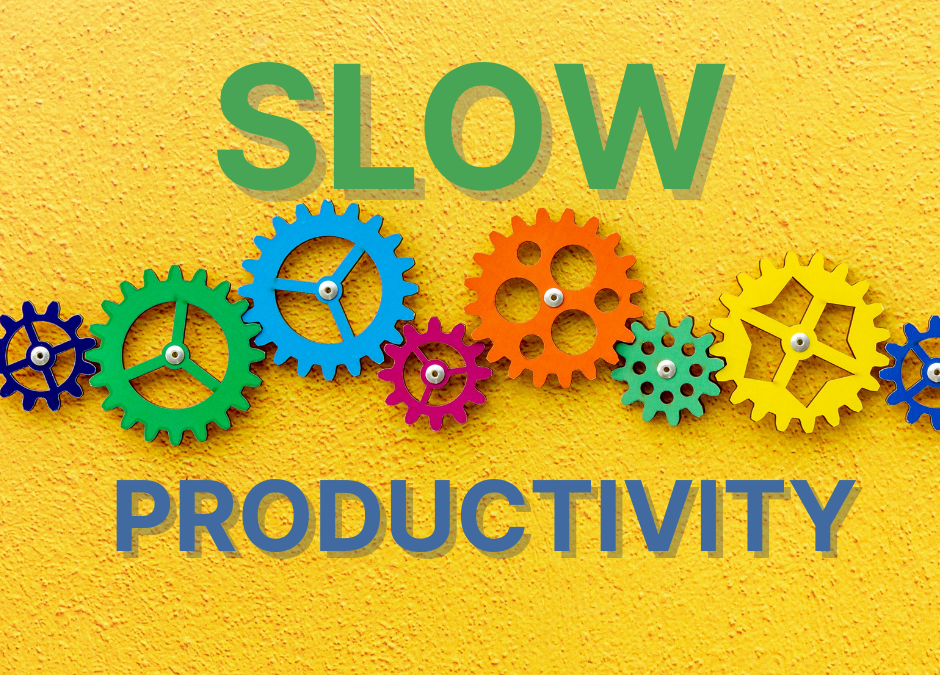
In his book Slow Productivity, Cal Newport challenges the modern obsession with speed and output. Instead of chasing endless tasks, Newport proposes three principles for knowledge workers and academics: do less, work at a natural pace, and obsess over quality. The promise is not laziness, but sustainability, building careers and lives that resist burnout while still producing meaningful contributions.
This idea resonates deeply with the broader Slow Movement, which began with Carlo Petrini’s Slow Food protest in 1986 and has since expanded into slow cities, slow education, and even slow democracy. At its heart, the philosophy is simple: quality over quantity, depth over speed, presence over distraction. It is not about rejecting progress, but about seeking the right pace.
Applied to leadership in the age of AI, slow productivity offers an essential counterbalance. Leaders cannot and should not try to compete with AI in terms of raw efficiency or information processing. Machines will always calculate faster, process more data, and execute repetitive tasks more reliably. What humans can offer instead is creativity, judgment, empathy, and vision.
A “slow leadership” mindset means:
-
Doing less, but better: focusing teams on a few transformative goals rather than scattering energy across countless initiatives.
-
Working at a natural pace: creating environments where reflection, dialogue, and iteration are valued over constant urgency.
-
Obsessing over quality: guiding AI tools not toward maximum output, but toward meaningful impact aligned with human values.
Just as the slow movement calls for savoring food, travel, and even conversation, slow leadership calls for savoring the process of thinking and creating with AI as a partner. Instead of rushing to adopt every tool, leaders can pause to ask: How does this technology serve people?
The formula is simple yet powerful:
Slow Productivity = Sustainability
Ultimately, embracing slow productivity in leadership is not about resisting technology, it is about guiding it. By working with deliberation and focus, leaders can ensure that AI amplifies human imagination rather than eroding it. In a world that celebrates speed, choosing slowness may become the most radical, and effective, leadership strategy.
Inspiration:
- Slow movement (culture): https://en.wikipedia.org/wiki/Slow_movement_(culture)
- Slow Productivity: The Lost Art of Accomplishment Without Burnout, Author: Cal Newport
- The Huberman Lab podcast: https://youtu.be/p4ZfkezDTXQ?si=6TshErfblzbgR1eG